











THE toughest challenges are those that people do not see coming.
The COVID-19 pandemic, super typhoons, earthquakes, and accidents — businesses and families would not have made it through without the support of one economic sector: the insurance industry.
This report explores the current state of the Philippine insurance sector and its likely outlook amid the combined efforts from the government and industry players to make the industry more inclusive, digitalized, and resilient, among other initiatives.
Robust 1Q2026 performance
When Insurance Commissioner Reynaldo Regalado said that “the insurance industry remains firmly positioned to meet policyholder needs and deliver on its commitments with stability and resilience,” he was not exaggerating. The latest industry performance tally for the quarter ending last March 31 reflects a strong showing on all fronts (See Table 1).
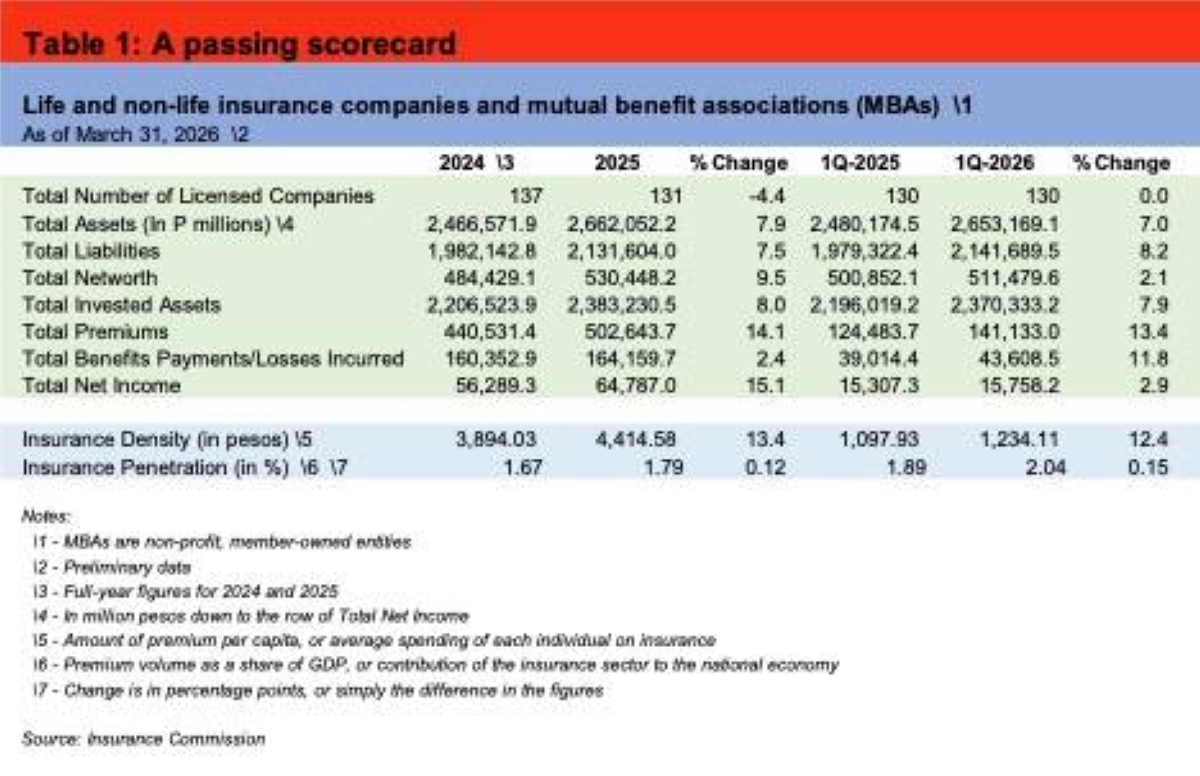
The number of licensed insurers totaled 130 companies for the period in review. These comprise life and non-life insurers, and mutual benefit associations (MBAs), which are non-profit, member-owned insurance organizations.
Despite the absence of any additional players from 1Q2025 to 1Q2026, the industry’s total assets grew 7 percent to P2.65 trillion. Even if one adjusts the figures for increases in the nationwide general price level, the industry’s total assets would still have grown by around 4.4 percent in real terms. At P2.65 trillion, the insurance industry’s asset base is substantial, accounting for nearly 10 percent of the domestic economy.
Altogether, the insurers paid out P43.61 billion in benefits, reflecting 12 percent growth from last year. As premiums collected rose 13.4 percent to P141.13 billion, insurers generated a 3 percent increase in net income to P15.76 billion in 1Q2026.
Life insurers dominate market
In terms of premiums, the biggest share went to life insurers.
They captured the lion’s share of around 82 percent with premiums amounting to P115.31 billion in 1Q2026, data from the Insurance Commission (IC) shows.
Non-life insurers were a far second. With overall premium collections of P21.53 billion, this segment accounted for 15 percent of the insurance industry's total revenues. Of the total non-life risk coverage, the largest share of 42 percent went to motor vehicles, followed by fire and accident insurance at 21 percent and 11 percent.
The remaining 3 percent of the overall insurance market has been contributed by MBAs.
In the life insurance market, Sun Life of Canada (Philippines) leads with P61.81 billion in premium income, IC data shows. This represents a 15 percent share of the P403.21 billion total for life insurers for all of 2025. This was followed by Pru Life UK (P52.84 billion, 13.1 percent), FWD Life (P52.47 billion, 13.0 percent), Allianz PNB Life (P37.66 billion, 9.3 percent), and AXA Philippines (P31.50 billion, 7.8 percent).
In the non-life segment, Pioneer Insurance & Surety tops gross premiums written at P20.70 billion (14 percent of the P149.11 billion total, excluding reinsurers and servicing companies), trailed by Prudential Guarantee (P13.86 billion, 9 percent), Malayan Insurance (P13.35 billion, 9 percent), BPI/MS Insurance (P8.48 billion, 6 percent), and Stronghold Insurance (P6.40 billion, 4 percent).
Insurance spending and economic growth
Many factors can drive insurance purchases, and one of them is economic activity. This can be seen by examining insurance premium data and the country’s real economic activity over the past decade or so.
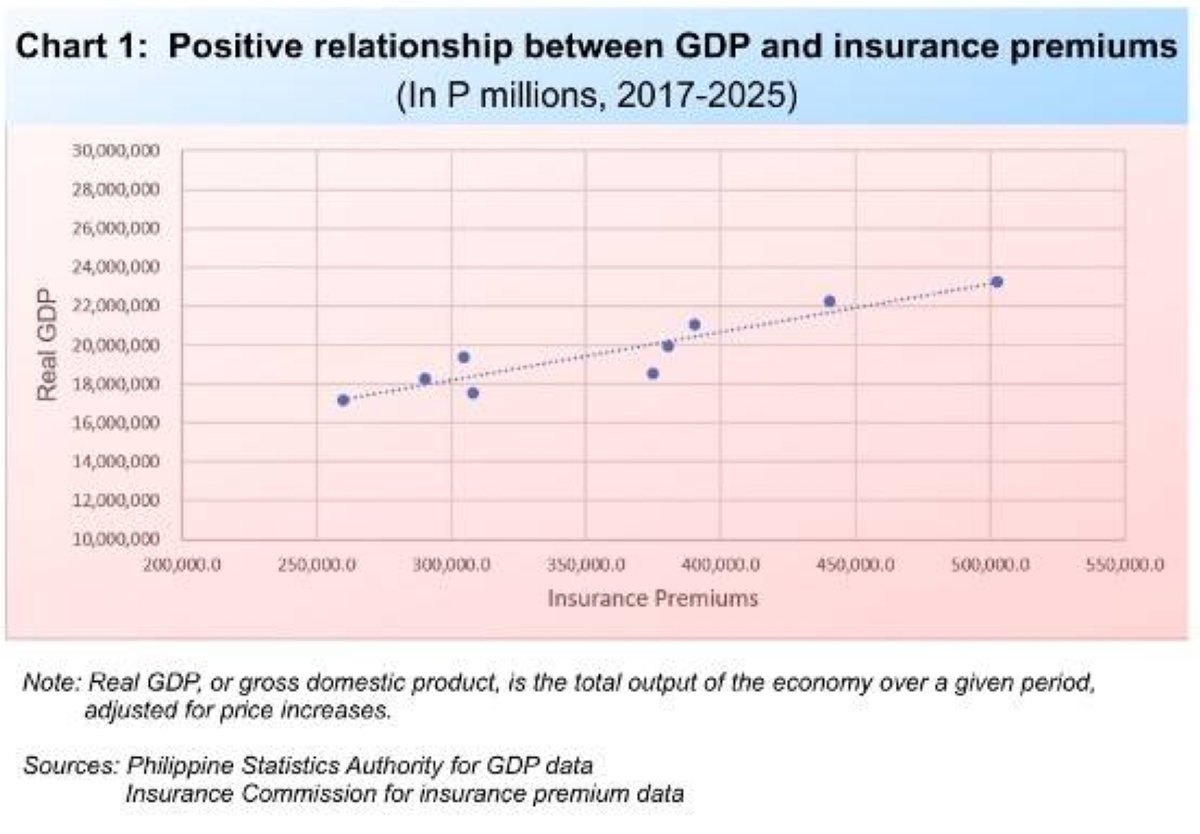
If one were to plot total premiums against real GDP (gross domestic product or the country's total output) on a graph, one would see a strong positive relationship between the two variables (See Chart 1). This is shown in the tight grouping of the plotted points forming an upward-sloping line. Simply put, when economic activity increases, people and businesses tend to buy more insurance. This is expected because a stronger economy implies more income to buy risk coverage. Moreover, as people and businesses accumulate more assets, they require more insurance.
Our computations show that a P1-billion increase in real GDP could likely result in a P34.5-million increase in gross premiums.
Proof of industry’s resilience
There is, however, something peculiar about how the level of economic activity affects the demand for insurance coverage. When the COVID-19 pandemic hit hard in 2020, real GDP slipped 9.5 percent (See Chart 2). At the same time, insurance premiums only slowed their growth to 1.2 percent; they didn’t decline. On the other hand, when the economy recovered in 2021 with a 5.7 percent growth, premiums shot up by 21.5 percent.
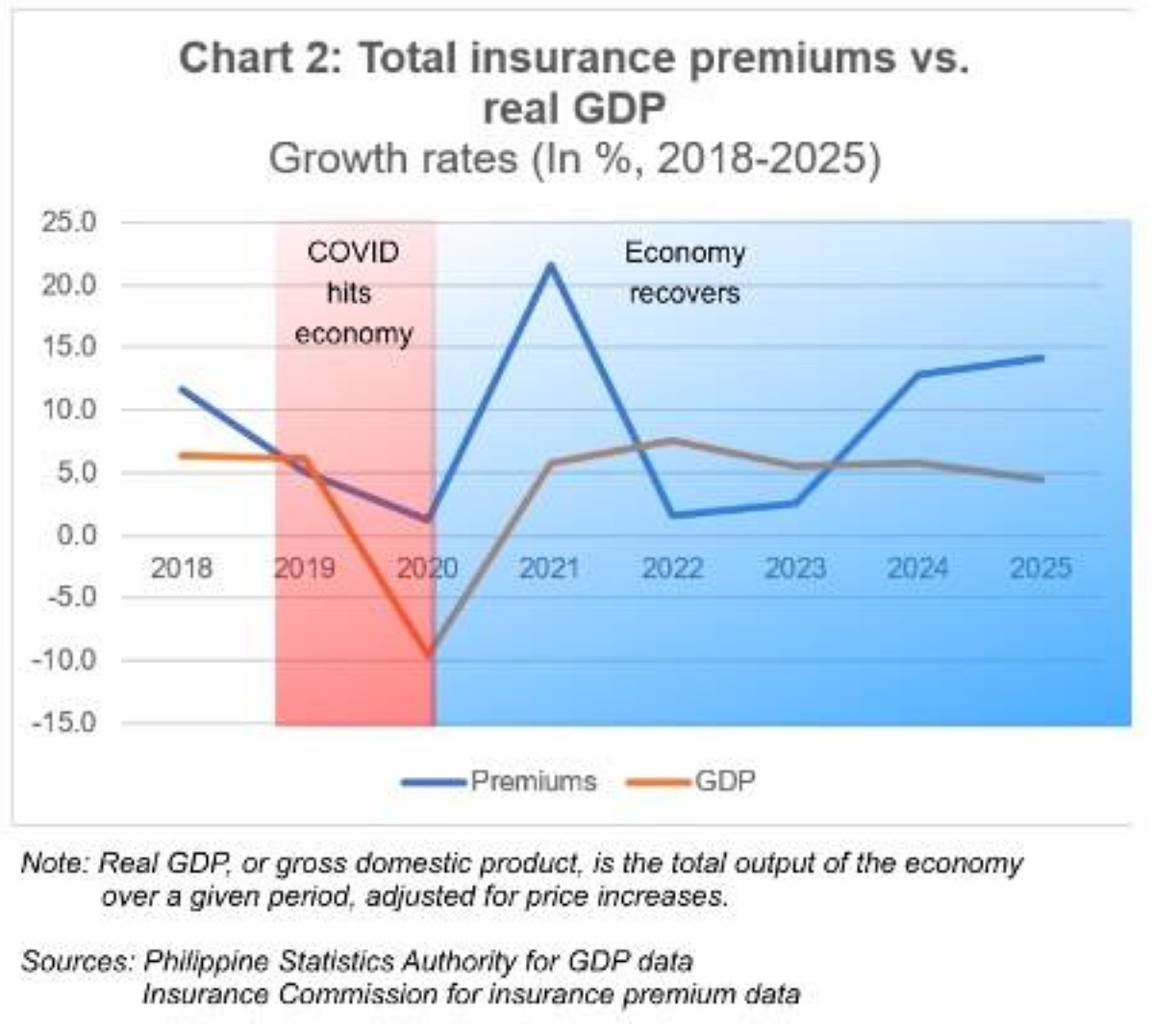
In short, insurance take-up weakens with the economy, but not as much. And when businesses are doing well, insurance purchases grow much more than the overall economy does.
These trends imply the industry’s resilience. They also show that businesses and families truly understand the important role that insurance plays in their operations and lives. Risk coverage is so crucial to ignore, especially during trying times, and it’s one of the purchases people and businesses make when they’re doing well. Such an underlying need for insurance lends the industry much promise for growth, so much so that even a small nudge can give it a definite boost.
There are other factors: bancassurance, microinsurance, digitalization and structural support initiatives. (See sidebar: Innovations and initiatives driving industry growth.) Taken together, these efforts point to an industry that is actively building the infrastructure, partnerships, and products needed to reach more Filipinos than ever before.
Raising low insurance density
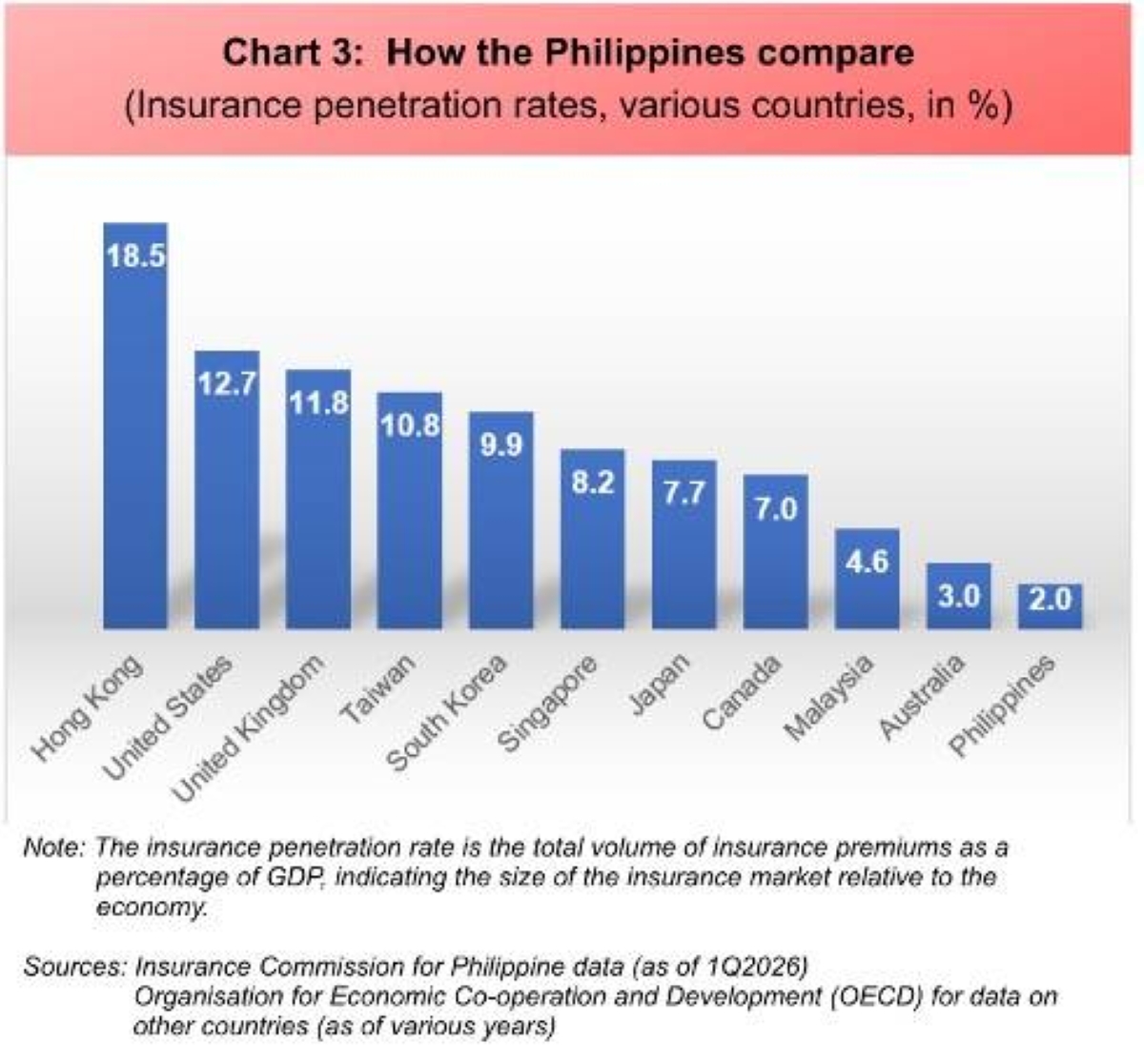
The abovementioned initiatives, together with economic stability, are seen to help address one of the industry’s most challenging problems – low insurance penetration. Computed as premiums as a percent of GDP, industry penetration breached the 2 percent threshold, reaching 2.04 percent in 1Q2026 (See Table 1). This developed as spending on insurance per individual in the country grew 12 percent to P1,234.11 in 1Q2026 from P1,097.93 in 1Q2025.
Despite the improvement in insurance penetration, there is still significant room for growth. The Philippines' 2.0 percent insurance penetration rate lags behind that of other countries. Looking at Chart 3, the country’s tally pales in comparison with countries like Hong Kong (18.5 percent insurance penetration), Taiwan (10.8 percent), South Korea (9.9 percent), Singapore (8.2 percent), Japan (7.7 percent), and Malaysia (4.6 percent), data from the Organisation for Economic Co-operation and Development shows.
Looking forward to a bright future
Moving forward, insurers will likely see continued growth in risk coverage. For the past decade or so, insurance premiums in the first quarter have averaged around 25 percent of the full-year total. If this is the case for 2026, insurers can likely look forward to writing an estimated premium volume of between P560 billion and P570 billion. This assumes the Philippine economy remains stable and no disasters occur for the rest of 2026.
Beyond this year, the industry could continue to expect a favorable business climate. This is considering that the economy would likely be easing from the oil crisis. Moreover, public infrastructure spending is also seen to resume after budgetary checks have been put in place.
Taken together, the data paint a picture of an industry on solid footing: one that held its ground through the pandemic's worst year and has only accelerated since. With the economy stabilizing and structural reforms in digitalization, bancassurance, and inclusion still gaining traction, the Philippine insurance sector's next chapter looks like a genuine, broad-based growth.
