












CHINESE transportation technology company Aridge, formerly Xpeng Aeroht, has completed a full-scale transition flight of its A868 electric vertical takeoff and landing (eVTOL) aircraft, demonstrating its ability to shift from vertical takeoff to fixed-wing flight. The milestone advances the Xpeng-affiliated company’s effort to develop longer-range electric aircraft.
Announced Nov. 23 in Guangzhou, China, the flight marks a major step beyond the A868’s initial hover tests, which began in November 2025. It demonstrates the aircraft’s ability to transition between vertical lift and forward cruise, then reverse the process for landing.
The A868 uses a full-tiltrotor configuration in which all rotors change orientation during flight. The rotors provide lift during takeoff and landing, then rotate forward to generate thrust as the aircraft transitions to wing-supported flight.
This configuration eliminates the need for separate fixed vertical-lift rotors during cruise, potentially reducing weight and aerodynamic drag. However, coordinating the rotors, flight controls and changing aerodynamic forces makes the transition technically complex.
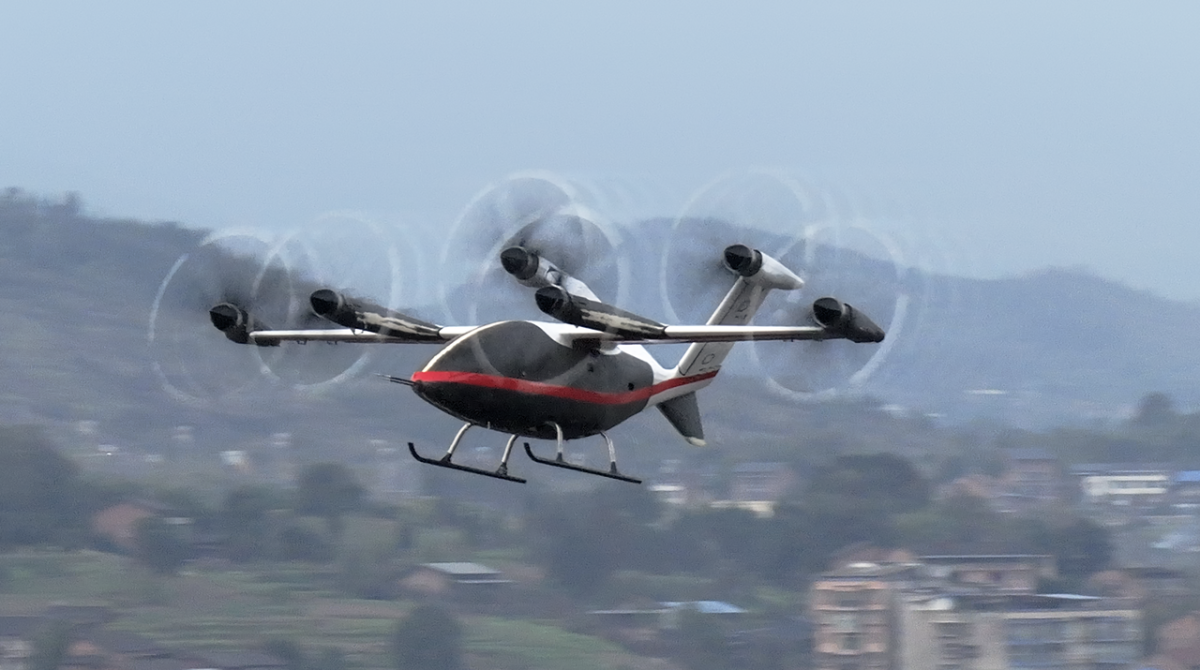
Aridge said the A868 uses a hybrid-electric powertrain designed for a range of about 500 kilometers and a cruising speed of 360 kilometers per hour. These are manufacturer-stated design targets, not independently verified performance figures.
The aircraft also features dual-winding electric propulsion motors designed to maintain power availability if one winding fails. Its redundant flight-control architecture is intended to preserve aircraft control in the event of a system failure.
The company is targeting the multi-passenger market, including business travel between urban centers. Its proposed range and speed place the A868 in the regional air mobility category rather than the short-distance urban air taxi segment.
The transition flight is an important engineering milestone but does not establish that the aircraft is ready for commercial service. Further testing must demonstrate consistent performance, system reliability and compliance with aviation airworthiness requirements.
US-based Joby Aviation has also demonstrated tiltrotor transitions with its electric aircraft, highlighting the competition to develop eVTOL designs that combine vertical takeoff and landing with the speed and efficiency of fixed-wing flight.
Aridge is the flying-car business formerly known as Xpeng Aeroht and affiliated with Chinese electric vehicle manufacturer Xpeng. Its other major development is the Land Aircraft Carrier, a modular system combining a six-wheel electric ground vehicle with a detachable two-seat aircraft.
While the Land Aircraft Carrier targets personal flying and recreational use, the A868 is intended for multi-passenger transportation. Together, the projects reflect Xpeng’s expansion into electric aviation and integrated ground-air mobility.
The next challenge for Aridge is to demonstrate that the A868’s flight performance and redundant systems can meet the safety, reliability and operating requirements of commercial aviation.
