












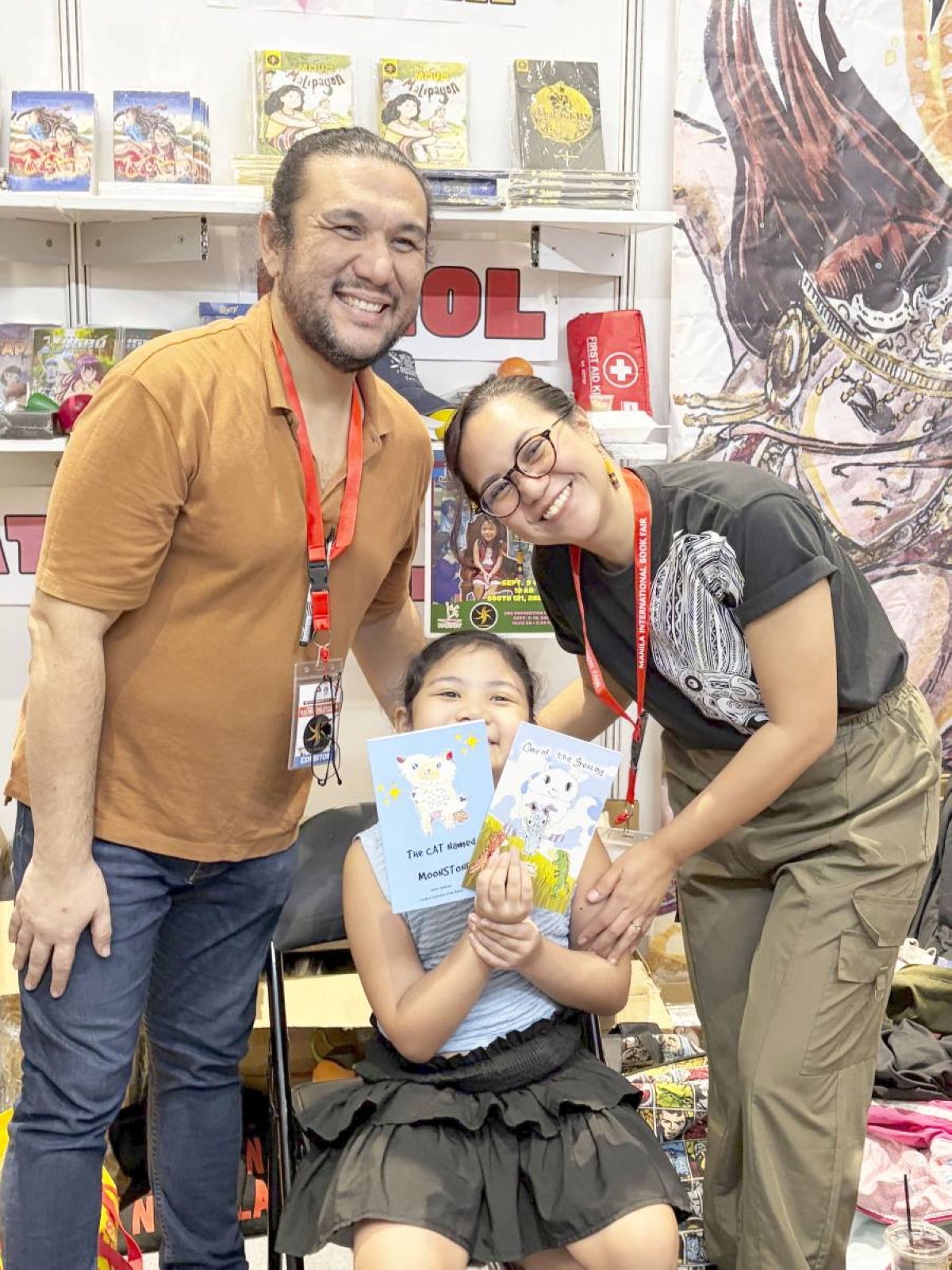
AT what age is a child too young to have their work published? When are young writers ready to hold a freshly printed book and realize that the words they once scribbled are now available for others to read? For Zena Chelabian and Mikaela “Ulan” Antonio-Abrera, these questions are no longer hypothetical. Their childhood ideas have become published works, reaching a wider audience at the 2026 Manila International Book Fair (MIBF) held Sept. 9–13.
For children like Zena and Ulan, publishing is about more than seeing their names on a book cover. It allows stories born from their imagination to find their way into the hands of readers.
Zena’s journey began at home.
Her mother, Faye Villanueva-Chelabian, is an illustrator and published author who wanted to pass on her love of books and reading to her daughter. From an early age, Zena was encouraged by Faye and her husband, Aria, to draw and explore her creativity.
They gave her the freedom to pursue her interests, eventually helping her produce her first two books: “One of the Greatest,” a story about dragons and friendship, and “The Cat Named Moonstone,” which tells how the family welcomed a white cat into their home.
While encouraging Zena’s imagination, her parents also taught her to weave positive values into her stories.
“The Cat Named Moonstone” recounts how the family’s adopted cat recovered and flourished under their care. Its message, Zena said, is simple: “Sometimes, all we need is a little love and care.” At eight, Zena is already writing stories whose lessons can remain with readers long after the final page.
‘Creativore’
Ulan, the author of “Dimensions,” approaches creativity in her own way.
She describes herself as a “creativore,” a word that reflects her appetite for reading and writing.
Her mother, Meryl Antonio, believes nurturing that creativity requires being present during her daughter’s formative years.
Meryl, a scientist at a water-testing laboratory in Quezon City, felt she had not spent as much time as she wanted with her firstborn. With Ulan, she decided to take a different approach.
“That is why I put her in a homeschool curriculum. I only have 18 summers to spend with her. I want to make complete use of them,” Meryl said.
Spending time with Ulan means more than simply being present, Meryl noted. It is also an opportunity to help her daughter develop confidence and critical-thinking skills.
The experiences of Zena and Ulan show how parents can help children turn their creative interests into tangible works. Parents do not need to be writers or artists themselves. Their encouragement can give children the freedom, resources and confidence to pursue their ideas.
Support can also come from mentors and creative communities.
Rober t Magnuson, a children’s book author and illustrator with more than 20 years of experience, helps nur ture young writers and ar tists through his workshops.
Best known for his “Duck and Croc” and “Mr. Beetle” series, Magnuson guides children in developing and publishing their own stories.
Teaching children, however, did not initially come naturally to him.
“I was afraid to teach kids at first because I didn’t really know how to talk to them,” Magnuson said. But after conducting several workshops for his publisher, he began to recognize the creativity waiting to be developed in his young students.
Magnuson encountered children with a wide range of personalities.
Some were shy and reluctant to show their work, while others were eager to share the products of their vivid imaginations.
For him, the difference often depended on whether children had an environment where they felt safe and encouraged to express themselves.
Like Faye and Meryl, Magnuson stressed the importance of parental support when children want to publish and sell their work. But he also pointed to the value of belonging to a community.
“Writing can be a lonely thing,” he said. “It is important to receive feedback from other writers.” When homeschooled children attending his workshops expressed a desire to publish their work, Magnuson collaborated with their parents to make it happen.
Some parents felt unable to contribute to the creative process because they lacked experience in writing or art. But they stepped forward when their children needed help with the practical aspects of printing, promoting and selling their books.
A child’s journey toward becoming an author does not happen in isolation. The story may begin in a child’s imagination, but bringing it into the world often requires a network of people willing to nurture it.
For Zena and Ulan, that network begins with their families. For Magnuson’s students, it extends to parents, mentors and fellow young writers.
At the 2026 MIBF, the combined efforts of these children and the adults supporting them produced something tangible: books bearing children’s names, displayed and sold alongside works by more established authors.
These young writers may still be too young to sign publishing contracts on their own. But with the help of parents, mentors and communities, their childhood ideas can become finished books — and perhaps reach far beyond the pages on which they first began.
The author is studying Diplomacy and International Affairs at De La Salle College of Saint Benilde
