












Read this in The Manila Times digital edition.
PRUDENCIO Miel, or DengCoy to everyone who has met or heard about him, was born an artist.
“I remember drawing almost every day, everywhere and on almost anything: paper, walls, on sand, leaves,” he tells Campus Press.
In this interview, he recalls his school days, early training, first jobs, working with the famous cartoonist Nonoy Marcelo, and being recommended by Jose Tence Ruiz to the Singapore Straits Times — all while nurturing his painting skills.
He shows no signs of stopping.
What do you remember most about your childhood?
I remember drawing almost every day, everywhere and on almost anything: paper, walls, on sand, leaves; making sculptures out of the rice mound on my plate; putting facial features on pandesal with whatever available na palaman, that kind of thing.
I also remember how my father would bring me books from the library. Got exposed to the works of Rockwell Kent, Arthur Rackham and others. My favorite was Wanda Gág. We had Free Press magazines lying around the house, also Current Events Digest.
Most kids have a natural skill in drawing. What did you like to draw while growing up?
My way of experiencing the world as a young boy was to draw everything in it, to process it visually. My mother was overprotective, so I couldn’t play rough with the neighborhood kids. I could only experience the world from afar as tactile drawings on paper.
I remember drawing the Apollo 11 rocket ship, the lunar module and the lunar rover. Copious amounts of them. And exploding volcanoes. I was into erupting volcanoes, with people running away in terror and being crushed by flaming boulders, being swallowed by cracks in the ground, and drowning in flowing lava. At 6 years old, I already had an apocalyptic worldview.
Did your teachers or classmates ever notice your budding artistic talent at the time?
I was the designated class artist from Grade 1 [at Catbalogan I Central Elementary School] until high school [at Samar National High School]. Na-kick out ako sa kinder ng mga madre dahil pinisak ko ang clay sculpture ng isang classmate ko — either that or I was pulled out ng mga kawawang magulang ko dahil doon. And with that, naging shortlived ang pagiging art critic ko.
Our elementary and high school teachers would make me draw diagrams on the blackboard, parts of the body, cross-section of a leaf, assorted schemas, mga ganoon. Staff artist din ako ng school paper namin.
Did you pursue art studies in college? What did you learn from formal art school?
Took up Painting at UP Diliman, graduated with a Master’s Degree in Design at the University of New South Wales in Australia. I learned more by reading, researching and experimenting on my own in college than by being with teachers, who would also encourage us anyway to be self-directed learners. One professor gave us a reading list on the first day of classes, tapos kita-kita na lang sa last day ng semester. I preferred that kind of approach. After all, aptitude is built in and is a given.
Tell us about your first few jobs as an artist, including the joys and struggles from the experience.
I was doing illustrations on the side as a student for The Diliman Review, UP Information Office, etc. I was also a staff artist at Sinag and the Collegian for a short while. Stipend was not enough. Art materials were costly, hindi rin kaya ng government employee salaries ng mga magulang ko.
I responded to an ad in Jingle Magazine in Cubao, which was near UP via Katipunan or EDSA. Upon receiving my salary of P800, I bought a Walkman and the Steely Dan “Greatest Hits” on cassette tape at Farmers Market.
You became the resident cartoonist of the Philippine Star. What did you learn from journalism?
Yes, I was one of the pioneer staff of Philippine Star, although I really started out at Philippines Daily Express. I was still in UP but was already submitting my cartoons to its then-editor, Pocholo Romualdez. He would always decide to run them even without an accompanying story in the opinion pages. I never thought of getting paid. Getting published, getting my work out there was enough for me.
As a visual journalist, I learned to be patient with high volumes of text, to digest them carefully, to understand them deeply and to paraphrase them as imagery. Deadlines, especially tight ones, were very useful because I was able to develop a shorthand to ideation, drawing style and approaches without sacrificing quality.
At about the same time you were assisting Nonoy Marcelo in drawing Ikabod. How did you hook up with him?
I was then working at Jingle with my childhood cartoonist idols like Rox Lee. When I did an Ikabod drawing on a photograph, Rox saw it and then asked if he could have it. Turned out that he took it to Nonoy Marcelo. Nonoy sought me out and convinced me to stay with him at his San Vicente Bliss unit because it was near UP. How could I say no? So I occupied his storage room area where I could daydream and also do all the drawings for the Ikabod Komiks.
And then you flew to Singapore to work at the Straits Times. Was it also in Singapore that you started painting regularly?
Jose Tence Ruiz brought me into the Straits Times in 1992 because he wanted to go back to the Philippines. Singapore bosses wanted “somebody like him” as a replacement artist. Ako na pala iyon. I was already painting even before college or Singapore. Wala lang masyadong mga art galleries noon to have our works exhibited in.
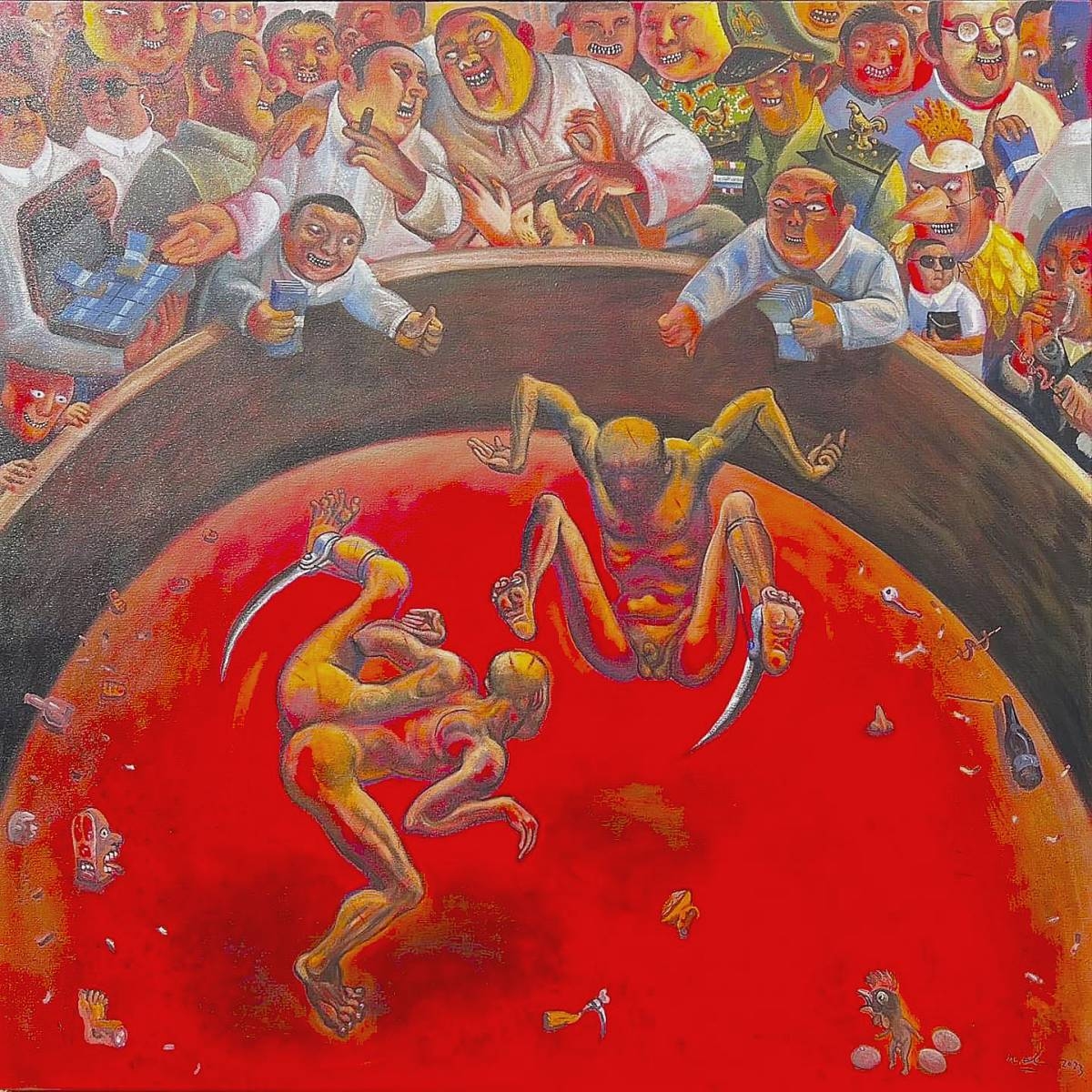
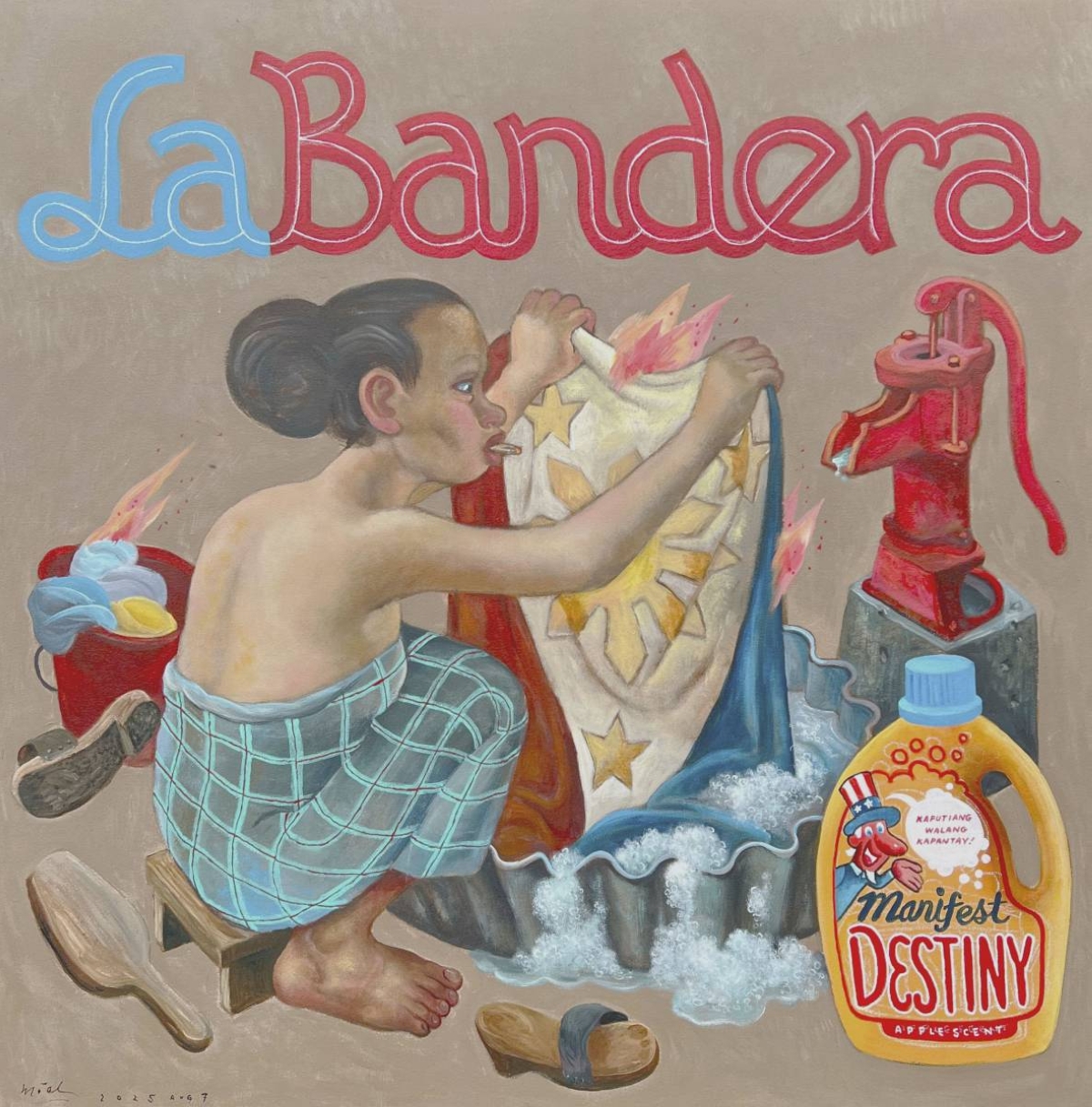
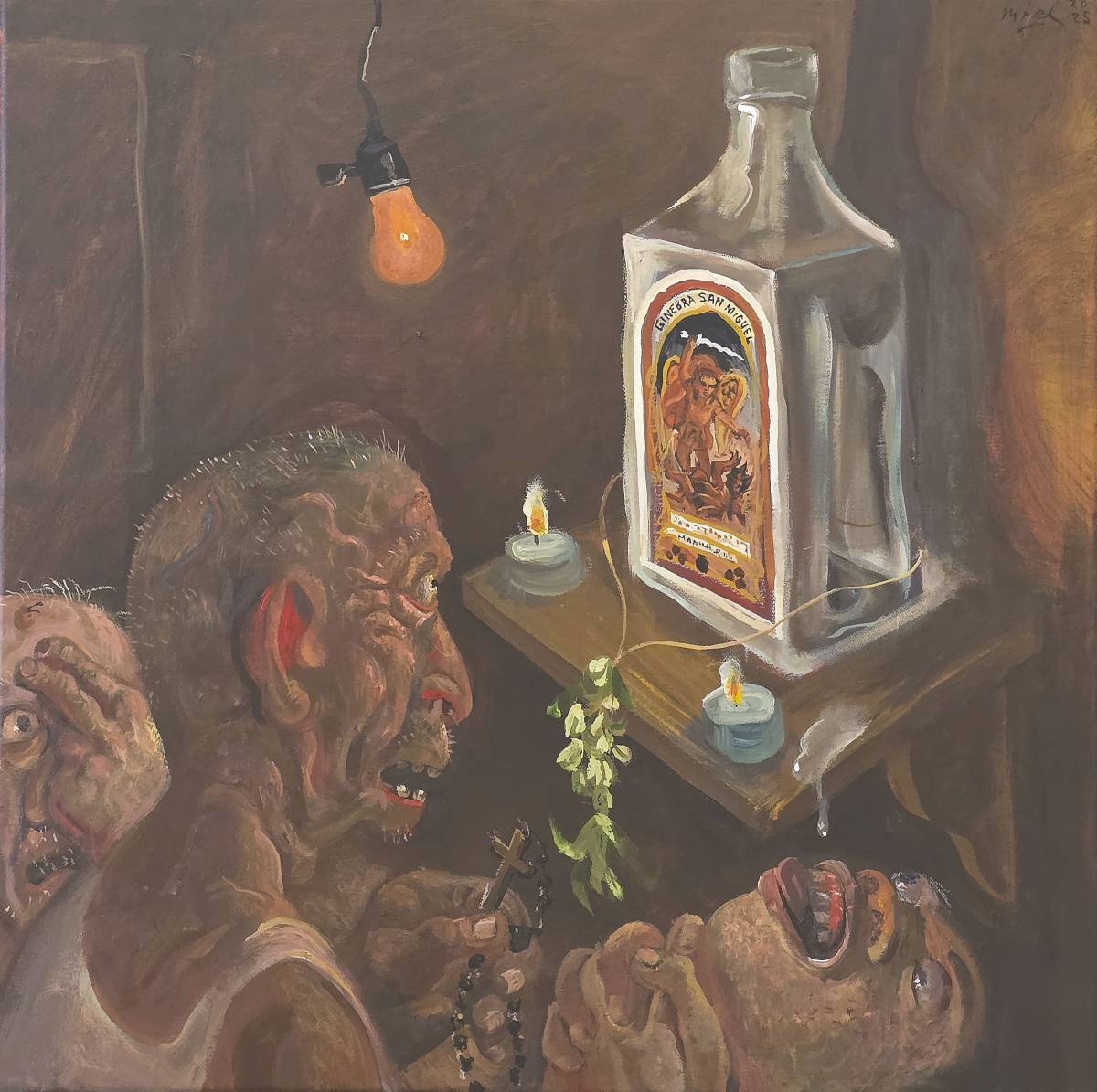
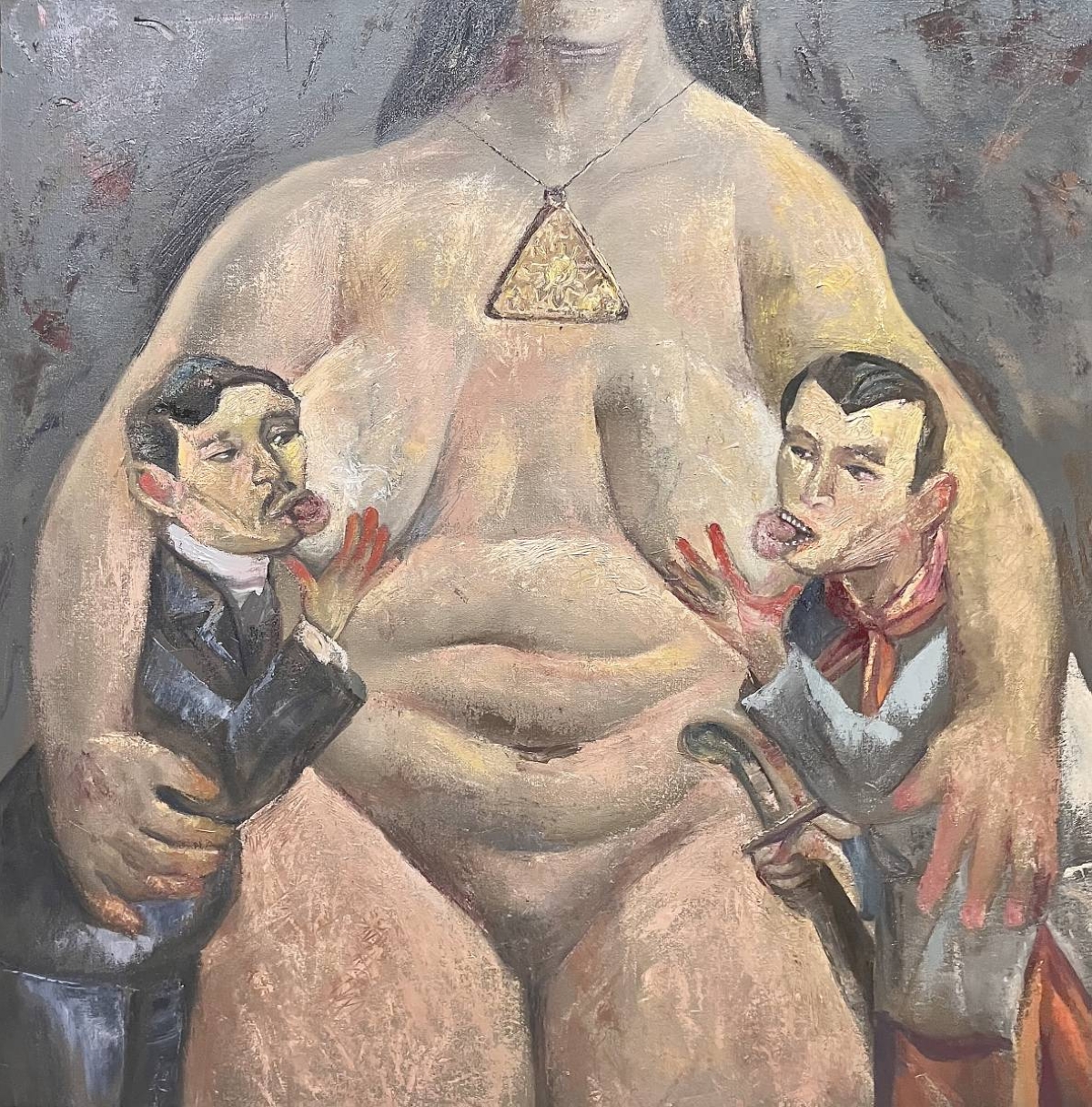
Your paintings are the opposite side of the traditional “fine art,” in the sense that they’re deliberately not pretty. But they have the power to shock, amuse, befuddle, enlighten, and generally make people think. How did you develop your style? Who were the artists who influenced you?
My style is that I don’t really have one. I don’t belong to any “ism” group out there. I don’t have a branding. I take what I can to project an idea in my head that works. My background as a cartoonist helps me a lot because I could approach and inject everything with humor so that it would appear innocuous, even if the subject matter, as touchy as religion or politics, for example, has transpierced through the threshold of what’s acceptable. Humor is the “gateway drug” to my paintings.
You also express yourself well in writing. Did you read a lot in school?
Yes, I do read a lot, short books, a 200-pager perhaps, which I could finish in a day or two, or in a week. For example, Joseph Brodsky’s “Watermark” or Italo Calvino’s “Collection of Sand.” Then I would reread them again much, much later, dahil nakakalimutan ko what was said or transpired, or purely just to revisit the pleasures of the text. Heavy tomes, quite intermittently. I have not finished Fyodor Dostoevsky’s “Crime and Punishment.” Sinimulan ko ito in the ’90s. Talagang parusa. Not to finish reading it might also be a crime.
What was the most expensive painting you sold and what did you do with the money?
Buy art materials primarily. The proceeds from my paintings would always finance my incursions into new, fresh or untried ideas. I use the money to survey approaches to art-making beyond the tried and tired, the formulaic, or the conventional.
What does listening to music do to you while painting?
I need to have something playing in the background while I paint, not too loud, parang nasa loob lang ako ng isang aural bubble where I would meld with my canvas undisturbed for hours. Music gets my paintings done — pag medyo kailangang matapos kaagad, I need to have something fast like Madness, The Specials, or Yoyoy Villame. Joe Jackson and Elvis Costello rin and Steely Dan, of course. And OPM to truly remind me kung sino ako.
